
Originally published: X Article — March 13, 2025
Series: Part 2 of 3
1 Sentence TLDR
Civilizational decision-making infrastructure is under strain. Let's fix it.
1 Paragraph TLDR
Traditional ways of knowing and decision-making are failing due to increasing complexity, rapid change, and collapsing trust in institutions. We need new 21st century ways to better navigate challenges and achieve more thriving in the modern world.
1 Page TLDR
The way we traditionally understand and make decisions is struggling under modern pressures like rapid technological advances, information overload, and declining trust in established authorities. These outdated methods are no longer effective in dealing with today's highly complex and rapidly changing world.
We need a modern way of understanding how knowledge spreads and evolves through networks. Instead of relying on traditional hierarchies or single authorities, we increasingly need to value collective intelligence and interconnected thinking. We can leverage insights from fields like game theory, systems thinking, and even memetics to enhance cooperation, reduce conflict, and promote better decision-making across groups. Technologies such as blockchain and decentralized networks are practical tools for implementing these ideas, enabling trust and coordination without centralized control.
Ultimately, adopting a networked epistemology could make us better equipped to tackle complex global challenges like climate change, economic inequality, and democratic dysfunction. By recognizing knowledge as something we build together, we can create more resilient, adaptive, and effective systems suited to the rapidly changing world we live in.
This is part 2 of a 3-part series:
- Our Choices, Our World: Collective Thriving in an Uncertain Future
- A New Epistemology: Individual & Collective Thriving in the 21st century (this article)
- Groundswell: Networked Foundations for a Networked World
Introduction
In "Our Choices, Our World," we established that humanity stands at a critical juncture where our collective decisions will shape which branch of the multiverse we inhabit. We explored how agency operates across a hierarchy of constraints, and how emerging technologies enable new forms of coordination. Now, we must ask: How do we know which paths to take? What frameworks should guide our decisions in this rapidly evolving landscape?
This is fundamentally an epistemological question. Epistemology—the study of knowledge itself—asks how we know what we know, what justifies our beliefs, and what constitutes truth. The industrial age gave us epistemological frameworks rooted in reductionism, hierarchical authority, and centralized expertise. These served us well in a world of relative stability and slow change, but they are increasingly inadequate for navigating the networked complexity of the 21st century.
We need a new epistemology—one native to networks, complexity, and emergent phenomena. One that helps us transcend false dichotomies between individual and collective, between competing economic systems, and between technological determinism and human agency. One that enables us to make better decisions amid uncertainty, with incomplete information, across unprecedented scales of coordination.
Why Our Current Epistemologies Are Failing
Many dominant epistemological frameworks inherited from the 20th century, including reductionism, hierarchical authority, and centralized expertise, are breaking down.
The challenges they face include:
- Information overload: The volume, velocity, and variety of information now exceeds what traditional gatekeeping institutions can effectively process and validate. It's hard to find signal you can trust.
- Networked complexity: Linear cause-and-effect thinking fails in complex systems where feedback loops, emergence, and non-linearity dominate.
- Trust decay: Centralized epistemic authorities (media, academia, governments) face declining trust while being simultaneously overwhelmed by the complexity they're tasked with interpreting.
- Coordination failures: Our ability to create problems at scale has outpaced our ability to solve them collectively, revealing the limitations of existing decision-making frameworks.
- Accelerating change: The pace of technological and social change has altered the feedback loops between action and consequence. In some places it's tightened the feedback loops, and in other cases broken them. In all cases, leaving traditional sense-making struggling to keep up.
The epistemological crisis we face isn't merely academic—it manifests in polarization, conspiracy thinking, institutional failure, and collective inability to address existential threats. If knowledge is how we navigate reality, our maps are increasingly inadequate for the territory.
Foundations of a New Epistemology
A 21st-century epistemology must extend what's working, while throwing away what's not. It can be built from first principles while embracing the networked nature of both reality and our understanding of it. Here are the core components:
Network Effects and Emergent Knowledge
Network effects – the phenomenon where a product or service becomes more valuable as more people use it – provide a powerful model for understanding how knowledge itself works in our connected world. Just as each new user of a communication platform increases its value for existing users, each new participant in a knowledge network can exponentially increase the collective intelligence available.
This helps explain why coordination at scale is both so powerful and so challenging. It is hard to bootstrap. But, when successful, networked knowledge systems can produce insights and solutions far beyond what any individual could generate alone. However, these same dynamics can amplify error cascades and information pathologies when feedback mechanisms are misaligned.
In blockchain networks, we see this principle at work in how the security and utility of public networks like Ethereum grow with participation. This is not just a technological phenomenon but an epistemological one – these systems become more reliable knowledge infrastructure as they expand and diversify.
Networkologies: Seeing the World Through Networks
Christopher Vitale's concept of networkologies offers a fundamental reframing of how we understand reality. Rather than seeing the world as composed of discrete objects or entities, networkologies views everything through the lens of interconnection, relationship, and flow. This isn't merely a metaphor but a recognition that networks constitute the underlying structure of reality itself—from physical systems to social relations to abstract thought.
In biological systems, we observe this in mycelial networks that connect forest ecosystems, neural networks that enable consciousness, and the intricate webs of genetic expression and protein interaction. In social systems, we see it in how influence, information, and resources flow through communities. Even our identities emerge not from isolated individuality but from the complex networks of relationships we participate in.
This perspective reveals how traditional hierarchical models—in governance, organizations, or conceptual frameworks—often fail to capture the complexity of real-world interactions. Network structures are inherently more adaptable, self-organizing, and capable of emergent behavior than rigid hierarchies. They balance between chaos and order through feedback loops rather than through centralized control, making them more resilient in the face of disruption.
Applying networkologies to our epistemology means recognizing that knowledge itself emerges through connection rather than isolation. Truth isn't discovered by individual minds working in silos but co-created through dynamic patterns of relationship. By embracing this network thinking, we develop conceptual tools better suited to navigating our interconnected reality.
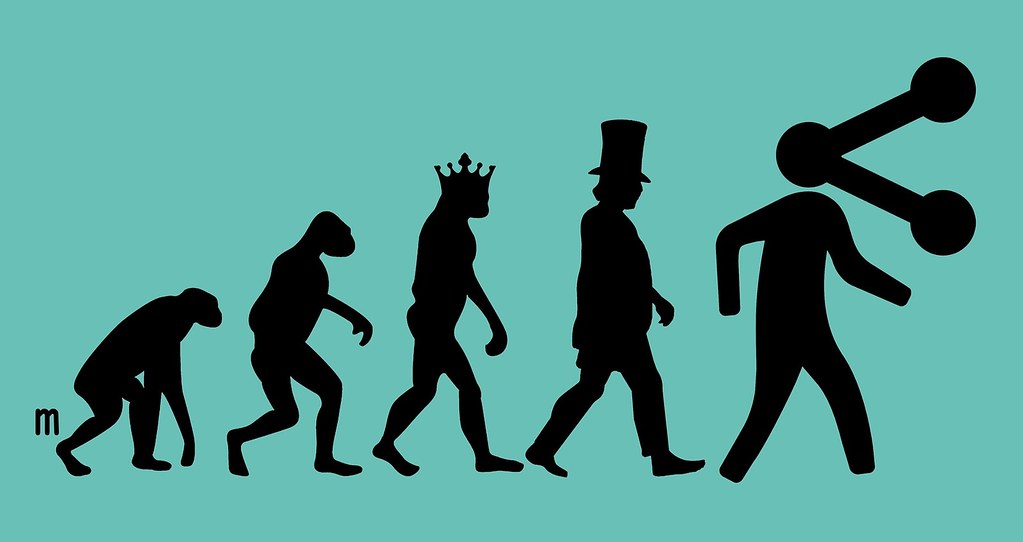
Memetics: Information Capsules for a Networked World
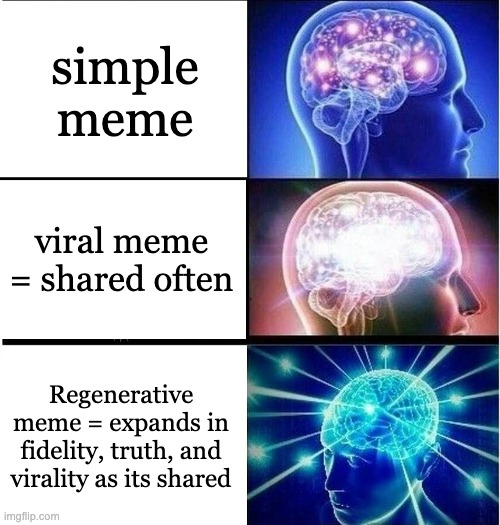
Memetics—the study of how ideas replicate, spread, and evolve—takes on heightened importance in our networked society. Memes function as information capsules, packaging complex ideas into transmissible units that can propagate across minds and communities. In a networked environment where attention is scarce and information abundant, the ability to create, recognize, and intentionally spread effective memes becomes a crucial epistemic skill. Those who understand memetic dynamics gain significant influence in shaping collective understanding and coordinating action.
The power of memetics lies in its ability to compress and transmit mental models efficiently. When we share concepts like "network effects," "skin in the game," or "credible neutrality," we're not merely exchanging words but activating entire conceptual frameworks in others' minds. The most powerful memes act as cognitive lenses that, once adopted, reshape how people perceive and interpret their reality.
In web3 communities, memetic phrases like "progressive decentralization" or "minimum viable decentralization" serve as coordination tools—establishing shared understanding that enables aligned action without requiring exhaustive explanation. Developing memetic literacy—the ability to recognize, evaluate, and consciously participate in memetic evolution—becomes essential for navigating a world where reality is increasingly co-created through shared narrative.
Reflexivity and Hyperstition
Reflexivity describes how our beliefs about systems can change those very systems, creating feedback loops between understanding and reality. Beliefs about asset values influence trading behaviors, which then influence actual values, creating self-reinforcing cycles that can lead to booms and busts.
Hyperstition takes this further, describing how fictional or speculative ideas can "bootstrap" themselves into reality. When communities act as if something is real or inevitable, they can make it so through their coordinated belief and action. The concept originated in cultural theory but has profound implications for how we understand the formation of social reality.
These dynamics are especially evident in Web3 communities, where shared narratives about possible futures directly shape development trajectories and coordination mechanisms. The "greenpilling" process itself can be understood as a form of hyperstition – by acting as if regenerative cryptoeconomics is possible, even inevitable, communities help make it so.
However, hyperstitional dynamics can also lead to harmful outcomes when they outrun actual value creation or become divorced from reality. The most dangerous hyperstitional dynamics occur when feedback loops detach entirely from reality-testing mechanisms, creating bubbles, manias, and collective delusions that can destroy value and undermine trust. This demonstrates why hyperstitional forces require robust epistemic frameworks that can distinguish between generative narratives that create actual value and speculative fevers that merely redistribute or deplete it.
Attractors and Schelling Points: Coordination Without Command
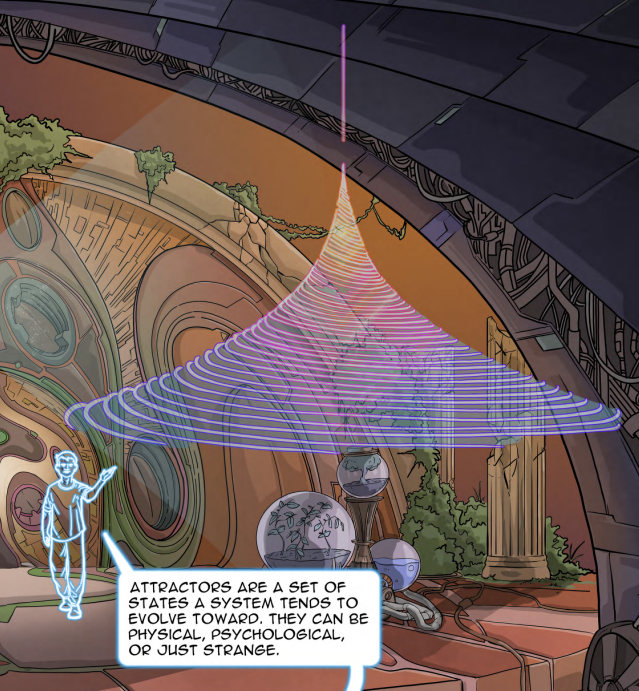
Schelling points (named after economist Thomas Schelling) are focal points that people tend to converge upon in the absence of communication, serving as natural coordination mechanisms in decentralized environments.
In complex systems without central coordination, the ability to create and recognize attractors—states toward which a system naturally evolves—becomes a fundamental skill.
Creating effective Schelling points & attractors involves understanding the underlying values, incentives, and mental models of a community, then designing structures that naturally draw participation toward desired outcomes. This is evident in successful crypto protocols, where well-designed tokenomics create attractors that align individual economic interests with collective protocol health without requiring top-down enforcement.
The art of attractor design represents a profound shift from industrial-age management, which relied on hierarchical control, to network-age coordination, which operates through shared gravity wells of attention and activity. When Ethereum established "minimum viable issuance" and "credible neutrality" as guiding principles, it created powerful attractors that continue to shape ecosystem development.
Similarly, retroactive public goods funding creates an attractor that pulls innovation toward socially beneficial outcomes by promising future rewards. Communities that develop a sophisticated understanding of attractors can achieve coordination at scales that would be impossible through traditional command structures. In a networked world where no one can control everything, those who can create compelling attractors gain outsized influence on emergent outcomes.
Game Theory and Multi-Polar Traps
The Prisoner's Dilemma elegantly illustrates how rational individual choices can lead to collectively suboptimal outcomes. In its classic formulation, two prisoners must decide whether to betray each other without communication. Though mutual cooperation would be best for both, the incentive structure often leads to mutual defection.
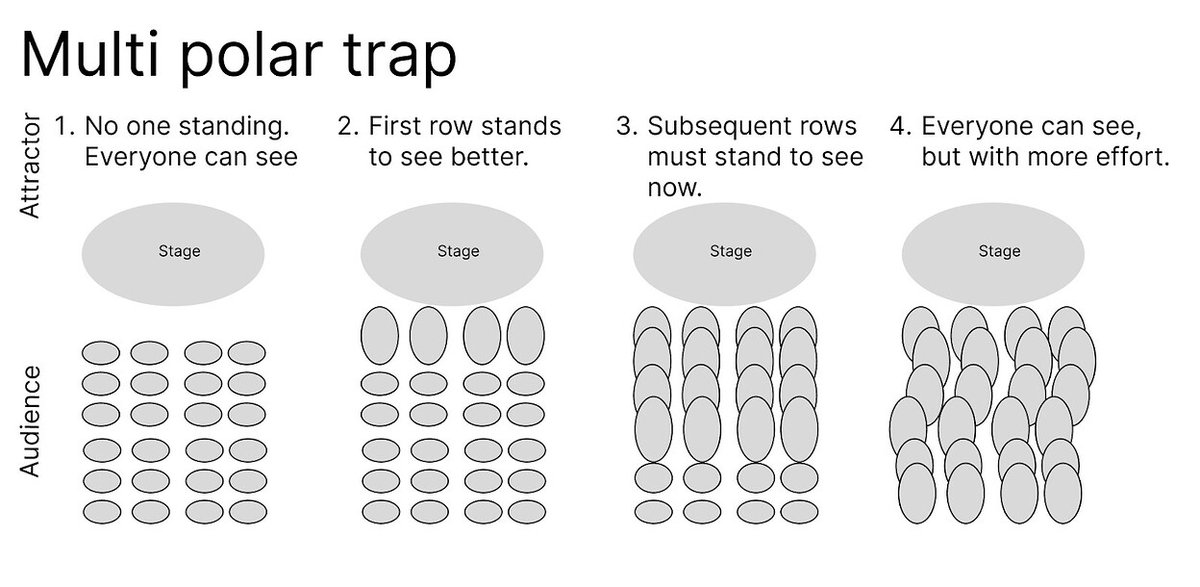
At a larger scale, these dynamics manifest as multi-polar traps – coordination failures where competing incentives lock us into destructive patterns that no individual actor can escape alone. Climate change, the attention economy, and the proliferation of weapons technologies all exemplify these traps, where what benefits individual actors undermines collective thriving.
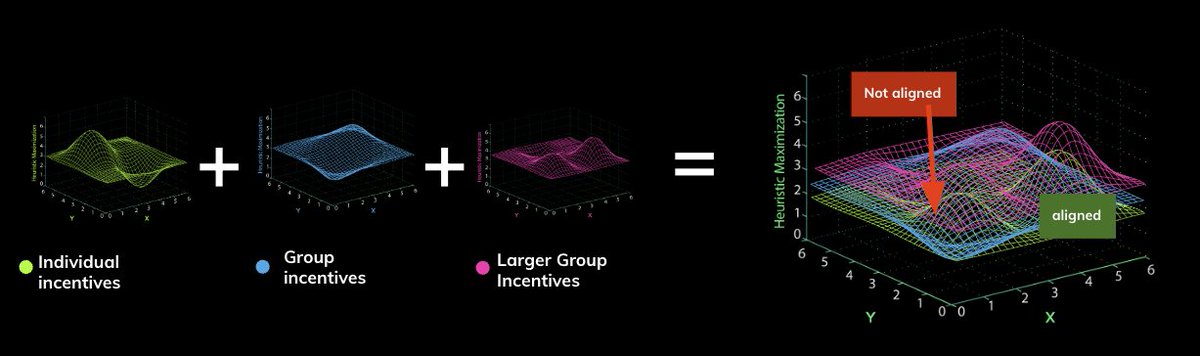
Regenerative cryptoeconomics seeks to engineer new coordination mechanisms that transform these game-theoretic landscapes, making cooperation the dominant strategy.
By encoding different rules of interaction in open protocols, we can potentially transcend multi-polar traps that have seemed inevitable under previous coordination paradigms.
Holons and Holarchies: Navigating Across Scales
Arthur Koestler's concept of holons—entities that are simultaneously wholes and parts—provides a crucial framework for understanding complex systems. A holon operates with both autonomy (as a whole unto itself) and dependence (as part of larger systems). For instance, a cell functions as an autonomous entity while also serving as a component of an organ, which itself functions as part of a body.
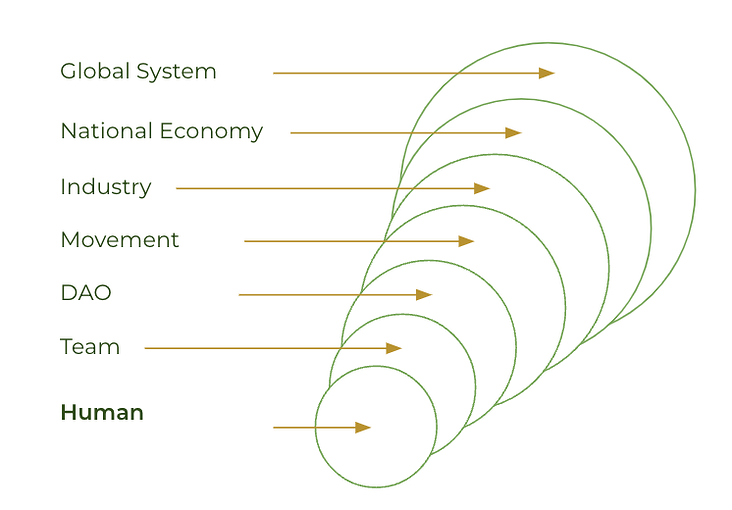
This holonic perspective helps us navigate across different scales of organization without reducing one level to another. In networked systems, understanding these nested relationships is essential for effective coordination. The concept of holarchies—hierarchies of holons—helps us map how influence and information flow both upward and downward across system levels.
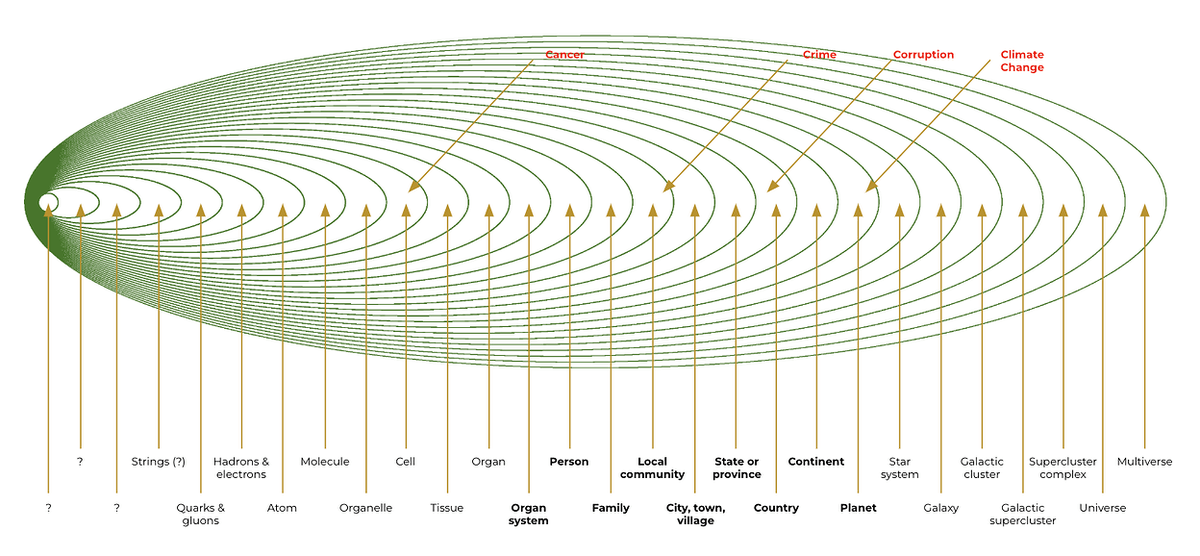
In Web3 ecosystems, we can observe holonic structures in how individual contributors participate in DAOs, which themselves participate in protocol ecosystems, which in turn form part of the broader cryptoeconomic landscape. Each level exhibits emergent properties that cannot be reduced to the levels below, yet remains dependent on those levels for its existence.
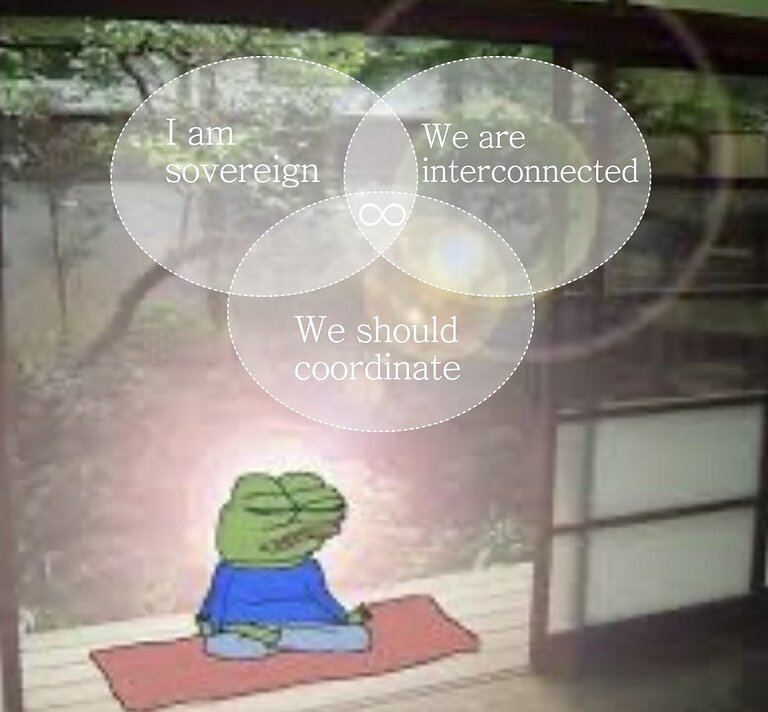
By learning to think fluidly at different holonic levels, we can transcend the dualism of individualism vs collectivism, local vs global, and learn to coordinate up and down the holarchies of different levels.
Bentoism: Beyond Near-Term Orientation
Yancey Strickler's framework of Bentoism (Beyond Near-Term Orientation) provides a valuable model for expanding our epistemological horizons. It maps decision-making across four domains: Now Me (immediate self-interest), Future Me (long-term self-interest), Now Us (immediate collective interest), and Future Us (long-term collective interest).
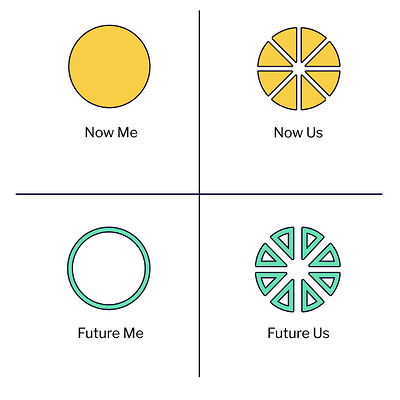
Traditional economic frameworks prioritize the Now Me quadrant, while our most pressing challenges require operating in the Future Us quadrant. A networked epistemology must account for knowledge and value across all four domains, recognizing their interconnection rather than treating them as competing interests.
Traditional Bento Boxes contain 4 cells: Now Me, Now Us, Future Me, Future Us. This concept could be further extended with more granularity.
- "Future" could mean Tomorrow, 1 Week, 1 Month, 1 Year, 1 Decade, 1 Century, or anything in between.
- "Us" could mean 2 people, 5 people, 15 people, 50 people, 150 people, an entire city, nation, or world, and everything in between.
When designing coordination games it is possible to create games that are net-positive across this entire expanded bento box.
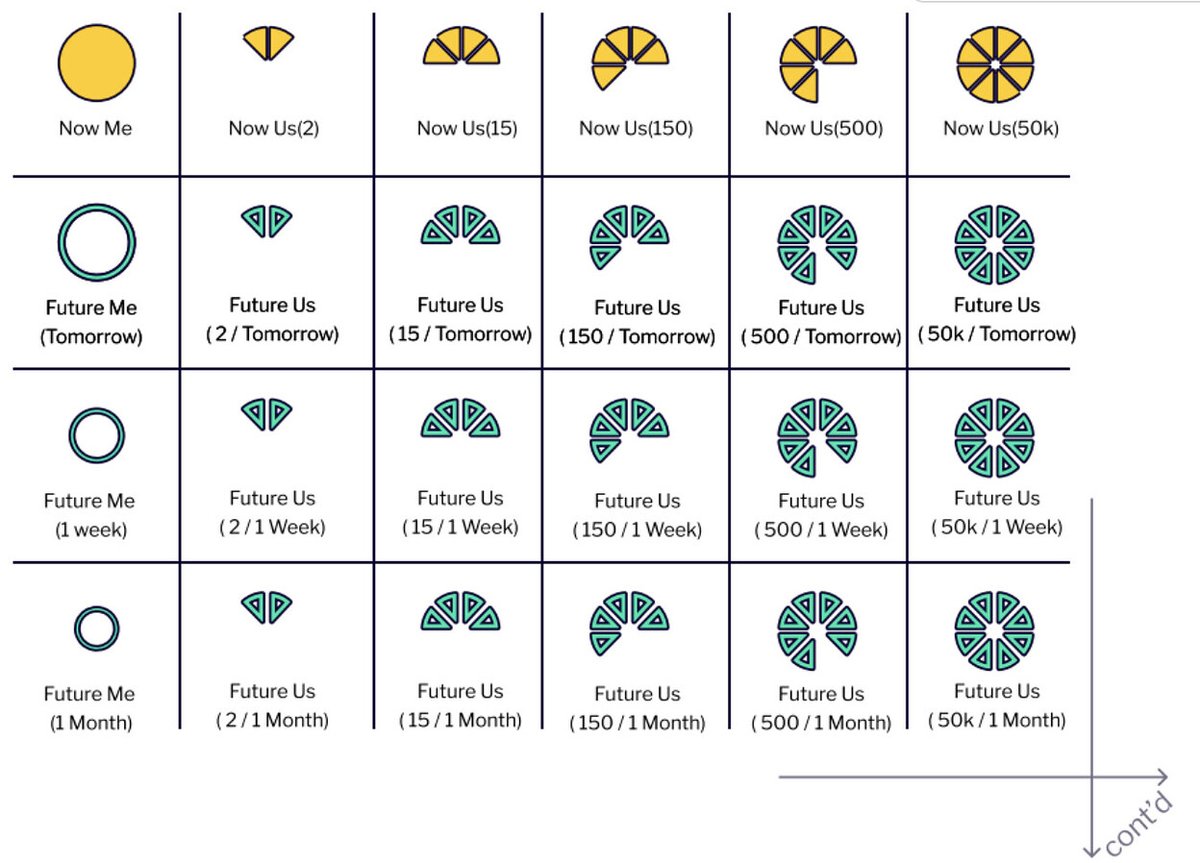
Ethereum Localism embodies this approach by creating infrastructure that aligns individual and collective interests across different time horizons, focused locally. By making Future Us considerations legible and actionable in the present, and visceral in our local community, these systems expand our epistemological range and enable more regenerative decision-making.
Zero-Sum vs. Positive-Sum Games
Our dominant economic and political frameworks often treat resource allocation as zero-sum – one person's gain is another's loss. This mental model shapes how we perceive possibility itself, limiting our capacity to recognize or create positive-sum arrangements where multiple parties can simultaneously benefit.
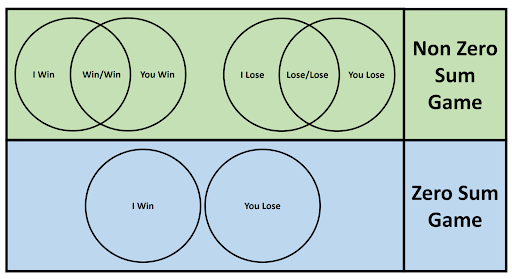
A networked epistemology recognizes that value creation isn't a fixed game. Through innovative coordination, we can expand the possibility space and create arrangements where all participants gain. Web3 mechanisms like quadratic funding exemplify this shift, creating mathematical frameworks that align individual choices with collective benefit.
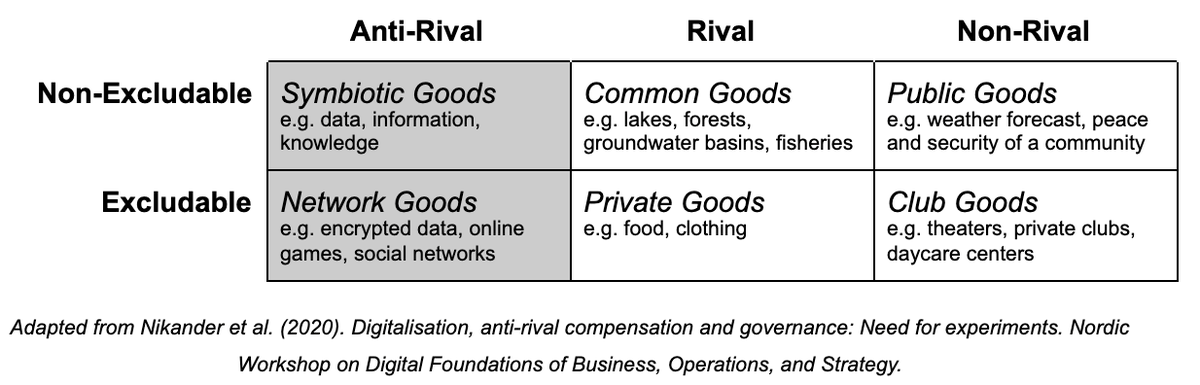
Network goods are an economic example of positive sum games:
- Private goods are excludable and rivalrous items—consumption by one person diminishes availability for others—such as a car or a sandwich.
- Public goods, in contrast, are non-excludable and non-rivalrous, meaning everyone can benefit simultaneously without reducing their availability, like national defense or clean air.
- Network goods build on these ideas by deriving increased value as more people use them, because their utility grows with each additional user, as seen in social networks, software platforms, and open source software where the interconnectedness itself boosts overall benefit.
Finite vs. Infinite Games
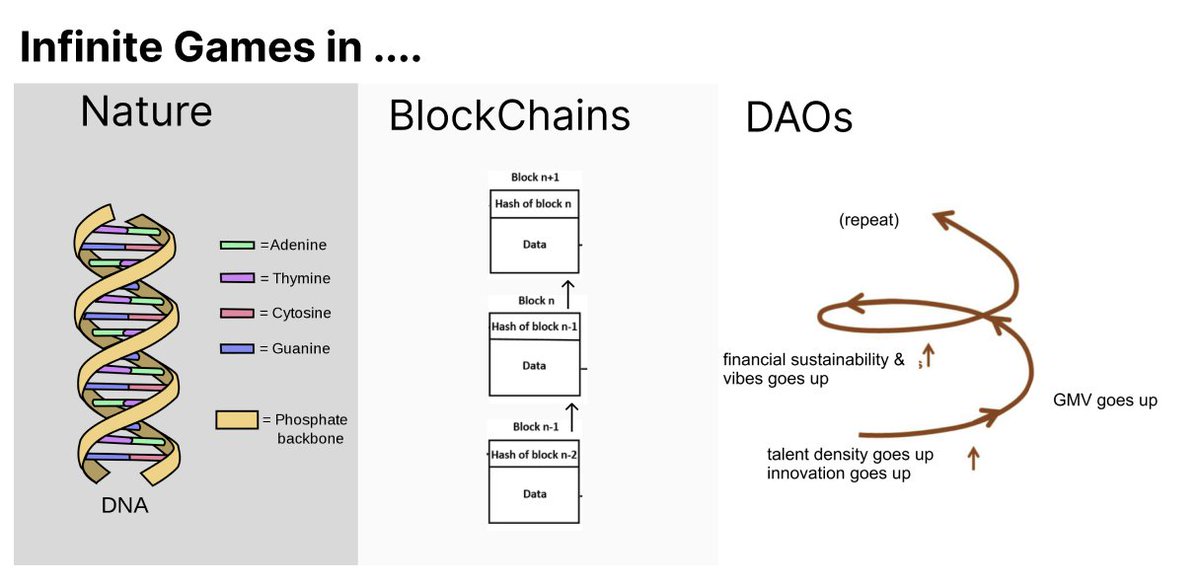
James Carse's distinction between finite and infinite games offers another powerful lens for our networked epistemology. Finite games are played to win within defined boundaries and timeframes—like chess matches, business quarters, or election cycles. Infinite games are played to continue play and invite others in—like scientific discovery, cultural evolution, or civilization itself.
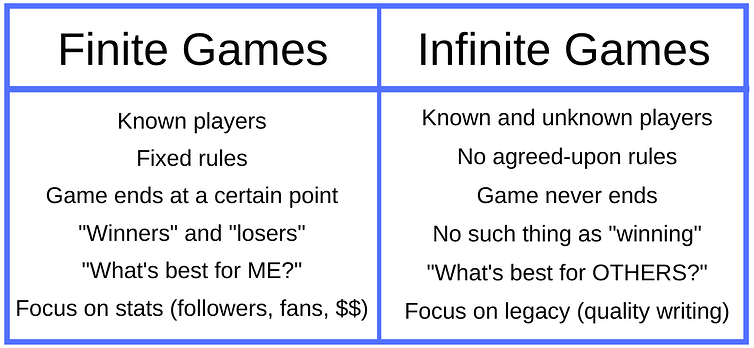
Most of our institutional structures are optimized for finite games, leading to short-term thinking and extractive behaviors. Yet our most pressing challenges—climate stability, democratic vitality, intergenerational justice—are inherently infinite games. This mismatch creates systematic failure modes in how we address long-term collective challenges.
Blockchain technologies enable new mechanisms for balancing finite and infinite gameplay. Token economics can align short-term incentives with long-term value creation. Governance protocols can encode intergenerational commitments. Public goods funding can transform zero-sum competitions into positive-sum collaborations.
By consciously designing for infinite gameplay within our coordination systems, we can better navigate the tension between present needs and future flourishing—creating knowledge infrastructures that sustain rather than deplete the conditions for their own evolution.
Metacrisis
Daniel Schmachtenberger's work on the metacrisis frames our current challenges as emerging from the interaction of multiple crises – environmental, economic, epistemological, and existential. This perspective shows how our fragmented approaches to problem-solving often exacerbate other dimensions of our complex predicament.
We live in a time of metacrisis, where multiple systemic challenges—climate change, economic instability, geopolitical tensions—converge, creating an environment of uncertainty. Traditional institutions, built for an earlier industrial age, are struggling to adapt. Daniel's approach looks for the root of these problems, (their "generator functions"), as opposed to each individual crisis itself, to solve for them all at once.
The Third Attractor: Beyond Collapse or Control
Schmachtenberger frames our current situation as being pulled toward two primary attractors, each representing a distinct trajectory for civilization. The first attractor is collapse—where our interconnected systems fail to address existential challenges like climate change, biodiversity loss, or technological risks, leading to cascading failures across ecological, economic, and social systems. The second attractor is authoritarian control—where centralized power structures emerge in response to increasing chaos, offering stability and security at the profound cost of human freedom, innovation, and dignity.
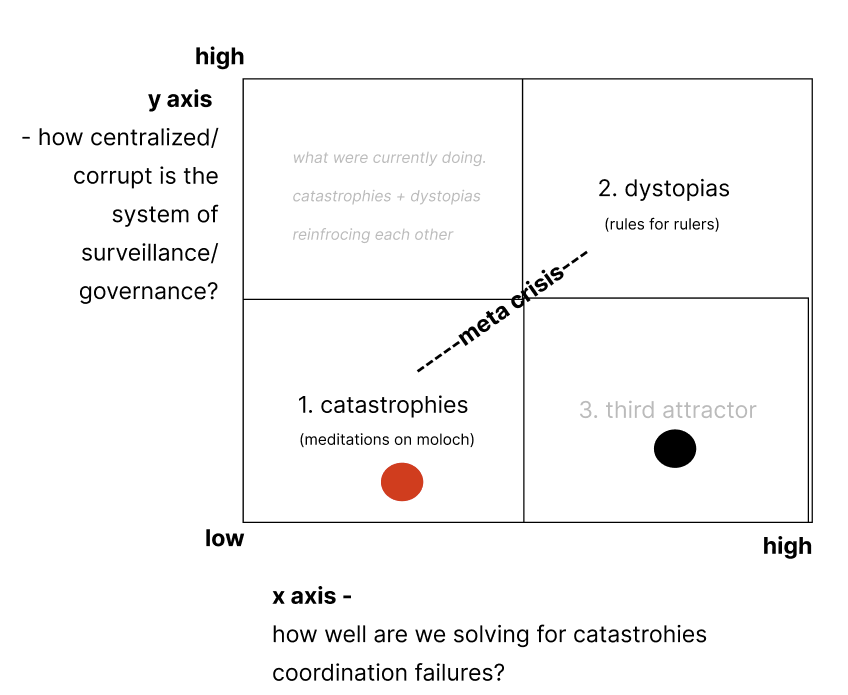
The third attractor envisions a regenerative, decentralized future where humanity leverages intelligence and technology to create thriving systems. This path isn't automatic—it requires intentional design of new institutions and coordination mechanisms that can navigate complexity without resorting to dystopian control structures.
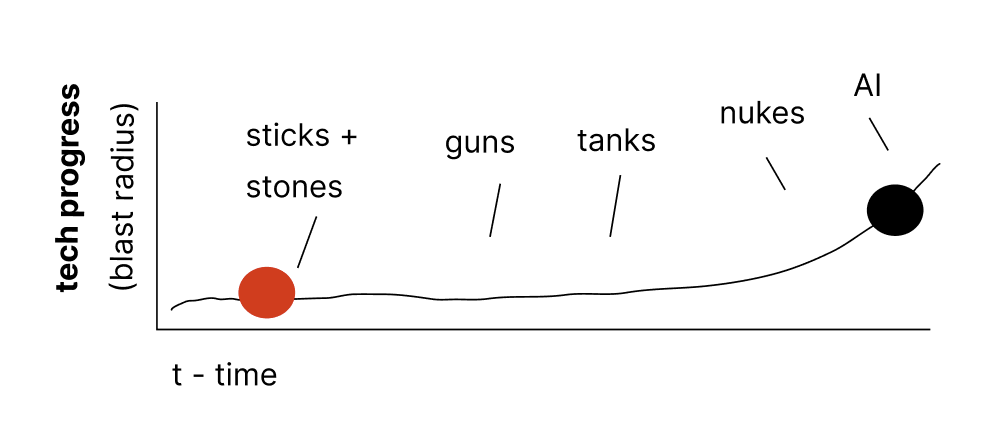
The expanding "blast radius" of technology makes this challenge especially urgent. As Schmachtenberger notes, technological power has grown exponentially—from sticks and stones with minimal reach, to weapons that could threaten civilization, to AI systems with unprecedented influence. Simultaneously, access to powerful technologies has democratized, moving from states to corporations to individuals. This combination creates both unprecedented risks and opportunities, making the development of appropriate epistemological frameworks a matter of existential importance.
The time to focus on this is now.
Expanding the Design Space
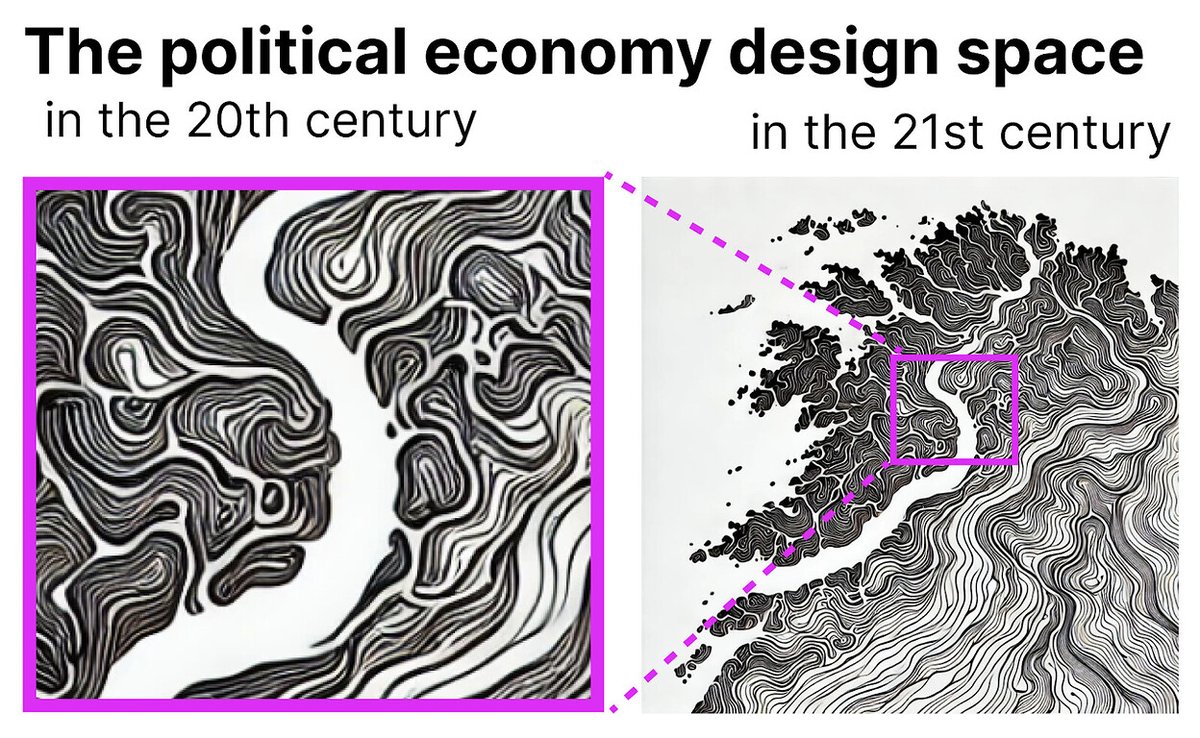
The constraints of our existing institutions dramatically limit the possibilities we can imagine and implement. By leveraging programmable trust infrastructure like Ethereum, and AI for larger context, we can expand the design space for coordination by orders of magnitude.
This expansion isn't merely quantitative but qualitative – enabling entirely new categories of social organization that weren't previously possible. From retroactive public goods funding to dynamic community currencies to cosmo-local production networks, we're witnessing the emergence of organizational forms that were literally unthinkable before the invention of programmable blockchains.
This expanded design space isn't just theoretical – it's already being explored through thousands of experiments in onchain capital allocation, governance, and coordination. Each successful implementation further validates the possibility of new institutional forms, creating an evolutionary landscape for social innovation.
Coordination Accelerationism
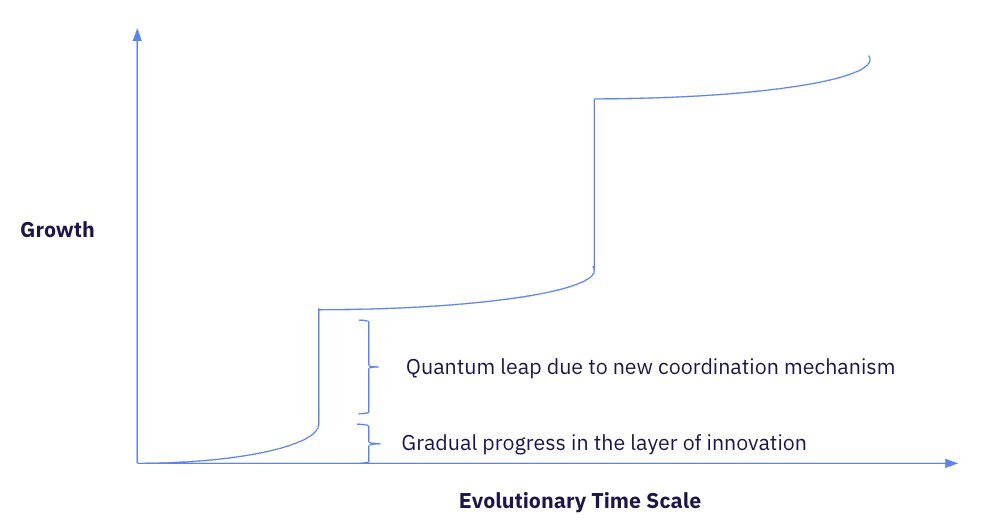
Sreeram Kannan, founder of EigenLayer, is the propagator behind the concept of "Coordination Accelerationism" - basically the idea that coordination - the idea that humanity needs to work together to solve their shared problems - needs an accelerant.
While artificial intelligence accelerates individual intelligence, blockchain technology accelerates collective intelligence by enabling decentralized trust, enforceable commitments, and new forms of cooperation at scale. This perspective recognizes that our ability to coordinate effectively is the primary bottleneck to solving global challenges.
Coordination can be understood as the sum of communication plus commitment. The internet revolutionized our ability to communicate globally, but did not significantly improve our ability to make credible commitments without centralized intermediaries. Blockchain technologies bridge this gap by enabling programmable, self-enforcing commitments that reduce friction in large-scale coordination.
Transcending False Dichotomies
Our inherited epistemological frameworks often force us into false dichotomies that limit our capacity to address complex challenges.
Rather than remaining trapped in 20th-century debates between capitalism, socialism, and communism, a network-native approach transcends those categories.
A network native approach recognizes:
- Markets, commons, and state provisioning all have appropriate domains
- Network effects create fundamentally different economic dynamics than industrial production
- New technologies enable coordination mechanisms beyond traditional binaries of planned vs. market economies
- Property rights exist on a spectrum, which should be defined and negotiated, rather than as a binary
Individual versus collective, capitalism versus socialism, global versus local – these polarities fragment our understanding and inhibit coherent action.
A networked epistemology transcends these dichotomies by recognizing their interdependence rather than their opposition. Individual and collective thriving are mutually reinforcing. Markets and commons can complement rather than contradict each other. Global protocols can enable local sovereignty rather than undermining it.
This integrative approach is evident in concepts like "cosmo-localism" from Ethereum Localism – "what is heavy is local, what is light is global and shared." Such frameworks don't collapse complex realities into simplistic either/or propositions but recognize the both/and nature of complex adaptive systems.
Tools for Implementation
Addressing these challenges requires metacognition – the capacity to think about our thinking itself. This includes recognizing the limitations of our mental models, the biases in our information systems, and the conditions that enable or inhibit effective sense-making.
This all isn't merely theoretical—it's enabled by concrete tools:
Ethereum
Ethereum is the canvas upon which 21st century coordination structures can be built. Ethereum and related technologies offer possibilities for extending our metacognitive capacities through shared computational infrastructure. By externalizing certain cognitive functions into collective systems, we can potentially overcome limitations in individual cognition while creating more robust collective intelligence.
Tokenization
Tokenization represents a fundamental shift in how we represent and exchange value. By creating digital assets that can represent anything from financial capital to reputation to governance rights, we enable new forms of fluid, programmable economic relationships. The epistemological implications are profound: tokenization makes previously invisible or informal relationships explicit and computationally legible. Social capital, contribution value, and impact can be recognized and rewarded through mechanisms that expand beyond traditional market valuations.
DAOs (Decentralized Autonomous Organizations)
DAOs represent experimental governance forms that distribute decision-making across stakeholder networks rather than concentrating it in hierarchical structures. Through various voting mechanisms, proposal systems, and treasury management tools, they enable collective intelligence to be applied to resource allocation and strategic direction. From an epistemological perspective, DAOs create new ways of knowing collectively—surfacing and integrating diverse viewpoints through explicit governance processes rather than relying on centralized authority.
AI Integration
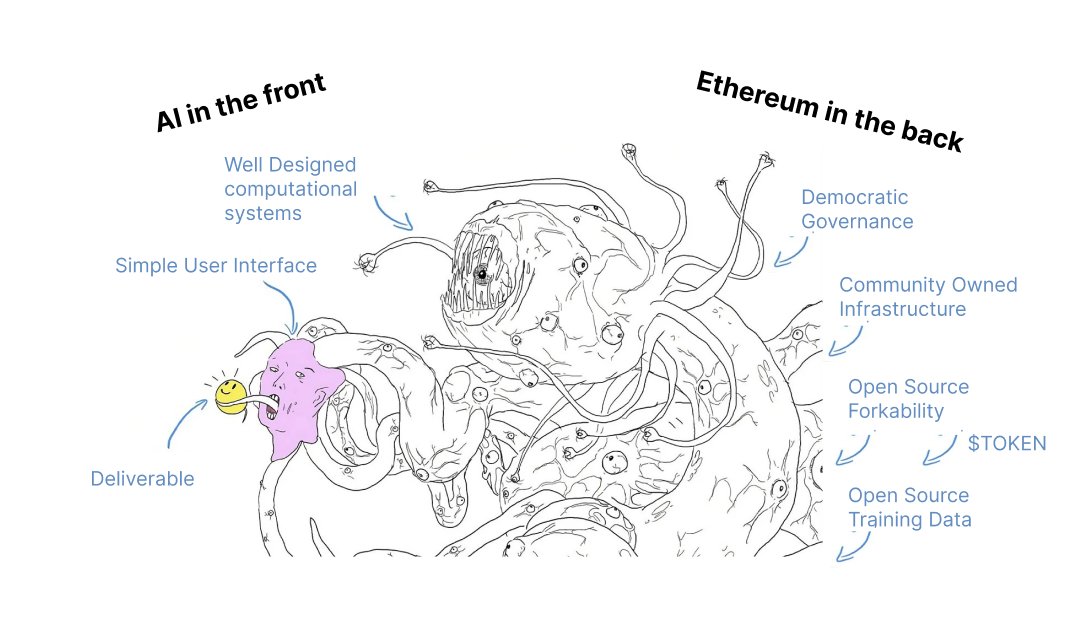
The integration of artificial intelligence with blockchain infrastructure creates powerful possibilities for extending human epistemic capacities. AI can help filter, analyze, and synthesize the vast information streams flowing through decentralized networks, making patterns visible that would otherwise exceed human cognitive bandwidth.
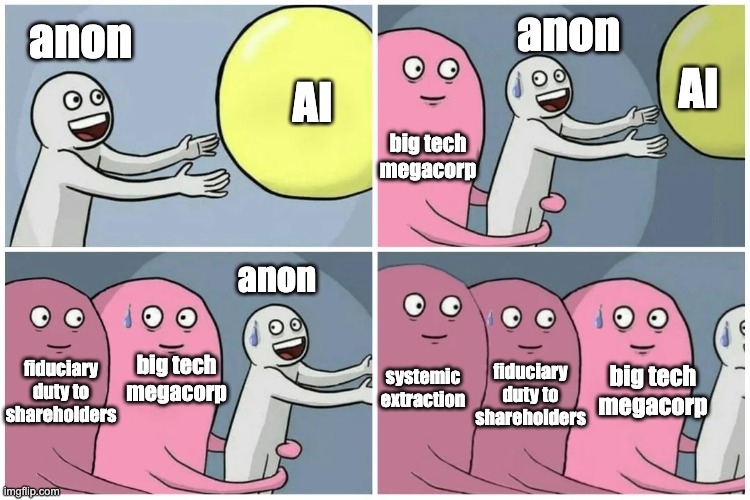
However, the current trajectory of AI development presents serious risks to our epistemic sovereignty. As AI systems become increasingly centralized in the hands of a few powerful corporations, they threaten to become new gatekeepers of knowledge. A networked epistemology demands a different approach—sovereign AI systems that serve the needs of everyday people and communities rather than corporate or state interests. This requires AI that is transparent, accountable, and aligned with regenerative values.
Blockchain and Cryptographic Primitives
Blockchain and cryptographic primitives provide essential infrastructure for networked epistemology by enabling new forms of trust, verification, and coordination. Smart contracts create the possibility of credible commitments—binding agreements that execute automatically without relying on centralized enforcement or trust between parties.
Beyond simple transactions, these primitives enable novel approaches to public goods funding. Mechanisms like quadratic funding mathematically align individual preferences with collective value, creating more effective ways to support commons infrastructure than either markets or states alone can provide.
Onchain Capital Allocation
New mechanisms for allocating capital—from quadratic funding to impact certificates to retroactive public goods funding—are creating more nuanced ways to direct resources toward value creation. Unlike traditional funding models that rely on centralized gatekeepers or simple market mechanisms, these approaches can better account for externalities, public goods, and long-term value.
Conclusion: Toward a New Collective Intelligence
The epistemology and the ways to achieve it outlined here isn't merely an academic exercise—it's a practical necessity for addressing the complex challenges of our time.
We are doing it. This post is itself a hyperstition. By practicing network dynamics, game theory, systems thinking, and positive sum games, we create frameworks capable of navigating unprecedented complexity while remaining fundamentally human.
This new epistemology enables us to:
- Transcend false dichotomies between individual and collective flourishing
- Create institutions that evolve and adapt rather than calcify
- Harness technology to expand rather than constrain human potential
- Build coordination mechanisms at scales previously impossible
- Navigate uncertainty with humility while maintaining the capacity for decisive action
The path forward isn't about choosing between competing ideologies or surrendering to technological determinism. It's about creating the conceptual and practical tools for collective thriving in a world of unprecedented complexity and possibility.
As we stand at this juncture between worlds, our epistemic frameworks—how we know what we know and how we make decisions together—may be the most important determinant of which branch of the multiverse we collectively choose to inhabit.
By recognizing knowledge as an emergent property of networks rather than merely an individual possession, we open new possibilities for addressing our most pressing challenges. Climate change, economic inequality, democratic decay – these aren't simply policy problems but manifestations of coordination failures rooted in outdated epistemological frameworks.
The thousand projects blooming in the Ethereum ecosystem – from Gitcoin's capital allocation mechanisms to Protocol Guild's contributor support system to the bioregional organizing networks emerging through Ethereum Localism, to countless others we've not yet mapped – are all laboratories for this new way of knowing and deciding together.
As Antonio Gramsci noted, "The old world is dying, and the new world struggles to be born: now is the time of monsters." Our epistemological moment is precisely this interregnum – between outdated frameworks that no longer serve us and emerging ones not yet fully formed. By consciously engaging with the conceptual foundations of our networked reality, we can shape the emergence of systems that enable both individual and collective thriving in the complex century ahead.
Civilizational decision-making infrastructure is under strain. Let's fix it.