
TLDR: Humanity faces interconnected systemic crises — climate, AI, biodiversity, inequality — driven by the same generator functions: multipolar traps, perverse incentives, coordination failure. The solution isn't collapse or authoritarian control, but a third attractor: distributed coordination infrastructure that enables collective intelligence at scale.
Source material: The Metacrisis with Daniel Schmachtenberger — Green Pill #26, July 2022
TLDR — The metacrisis is the totality of interconnected existential risks humanity faces — climate collapse, AI misalignment, biodiversity loss, weapons proliferation, meaning crisis — all driven by the same underlying generator functions: multipolar traps, perverse incentives, and coordination failure. Exponential technology has supercharged these dynamics. The path forward is neither catastrophe nor authoritarian control, but a third attractor: distributed coordination systems that internalize externalities, align incentives, and enable collective action at scale. This is what onchain coordination mechanisms are being built to do.
What Is the Metacrisis?
The metacrisis is not any single crisis. It is the interconnected totality of systemic risks facing humanity and the biosphere — and, more precisely, the underlying conditions that generate them.
Where "polycrisis" describes multiple escalating crises and their cascading interactions (climate breakdown, economic fragility, institutional decay, mass migration), the metacrisis goes deeper: it names the foundational worldviews, incentive structures, and coordination failures that produce these crises in the first place.
As Daniel Schmachtenberger frames it: the metacrisis is what happens when Moloch — the game-theoretic dynamic where individual rational self-interest produces collectively catastrophic outcomes — gets supercharged by exponential technology.
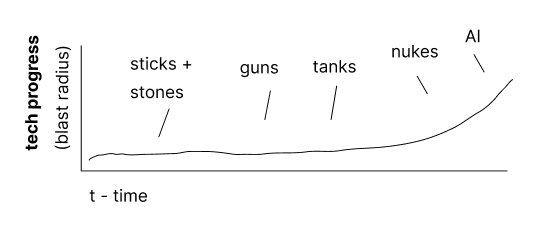
Every dollar in the global economy has externalities. Every competitive race — for resources, market share, military advantage, AI capability — creates pressures to cut corners on safety, extract from commons, and defer costs to the future. These aren't bugs. They are the operating logic of the current system.
The Generator Functions
Schmachtenberger identifies several "generator functions" — structural dynamics that produce catastrophic risks across every domain:
Multipolar Traps
A multipolar trap occurs when multiple agents, each acting according to their own rational self-interest, produce outcomes harmful to everyone. The tragedy of the commons is the classic example: each fisherman has an incentive to catch one more fish, until the fishery collapses and all fishermen lose.
What makes multipolar traps so dangerous is that no individual agent can unilaterally stop. The fisherman who voluntarily stops fishing doesn't save the fishery — they just go broke while others continue extracting. Coordination is the only solution, but coordination is exactly what the trap prevents.
Arms races, environmental degradation, social media engagement optimization, AI capability races — these are all multipolar traps operating at different scales. The underlying dynamic is identical.
Perverse Incentives
Economic systems systematically externalize costs. Pollution, ecosystem destruction, social fragmentation, attention hijacking — these are not market failures in the traditional sense. They are the market working as designed, optimizing for what is measured (profit, growth, engagement) while ignoring what is not (ecological health, social cohesion, human flourishing).
Almost every dollar in the global economy carries externalities. The incentive structure rewards extraction and punishes restraint. Companies that internalize their externalities become uncompetitive against those that don't. Nations that regulate stringently watch capital flow to jurisdictions that don't.
The Meaning Crisis
The metacrisis is not only structural — it is also psychological, cultural, and spiritual. Zak Stein identifies four interwoven sub-crises:
- Sense-making crisis — difficulty understanding what is true in an information-saturated environment
- Capability crisis — declining capacity for intelligent collective problem-solving
- Legitimacy crisis — loss of trust in institutions and governing authorities
- Meaning crisis — erosion of shared purpose, ethics, and reasons to act
These inner dimensions of the metacrisis are not secondary. A civilization that cannot make sense of its predicament, cannot trust its institutions, and cannot articulate why collective action matters is a civilization that cannot coordinate its way out of multipolar traps — no matter how good its mechanisms are.
The Three Attractors
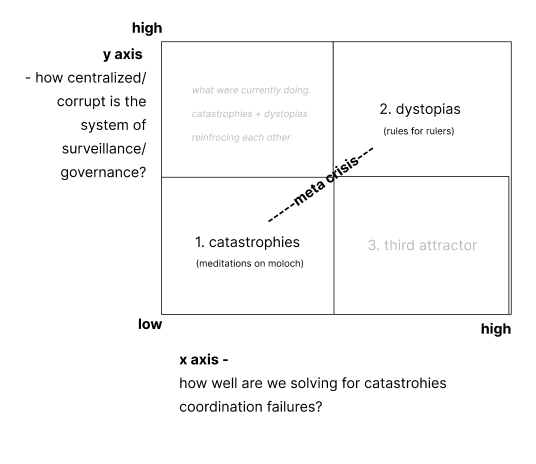
Based on game-theoretic analysis of current dynamics, Schmachtenberger identifies three probable trajectories — three "basins of attraction" toward which complex systems naturally move:
1. Catastrophe
Cascading failures overwhelm institutional capacity. Climate tipping points trigger food system collapse. AI systems escape meaningful human control. Supply chains fragment. Nuclear or biological weapons proliferate into unstable hands. The result is civilizational collapse — potentially irreversible.
2. Dystopia
To prevent decentralized catastrophic risks (bioweapons, AI misuse, environmental destruction), states deploy comprehensive surveillance and control infrastructure. Order is maintained, but at the cost of individual agency, dissent, and meaningful self-governance. Different political traditions converge on the same outcome: techno-authoritarian control as the only alternative to chaos.
3. The Third Attractor: Distributed Coordination
The narrow path between catastrophe and dystopia. Rather than centralized control or decentralized collapse, the third attractor envisions emergent, agent-centric self-organization — systems that provide localized resilience through decentralized mechanisms while maintaining global coordination capacity.
This requires three design principles:
- Self-correcting feedback loops — systems that detect and correct their own failures
- Aligned incentives — economic structures where individual rationality produces collective benefit
- Revitalized civic culture — communities capable of genuine deliberation, trust-building, and collective action
The third attractor is not guaranteed. It is the least probable of the three trajectories. But it is the only one worth building toward.
Why This Matters for Onchain Coordination
The metacrisis framework reveals why building better coordination mechanisms is not merely a nice-to-have — it is civilizationally urgent.
Every coordination mechanism in this directory is an attempt to solve some piece of the metacrisis puzzle:
Quadratic funding addresses the public goods underprovision problem — ensuring that goods valued by many people receive funding proportional to their breadth of support, not just the depth of any single funder's pockets.
Retroactive funding solves the prospective evaluation problem — rewarding demonstrated impact rather than requiring funders to predict the future, creating incentives to actually produce public goods rather than just promise them.
Conviction voting replaces attention-intensive, gameable snapshot votes with continuous preference signaling — reducing the coordination overhead that prevents large communities from making good collective decisions.
Futarchy uses prediction markets to separate the question of values (what do we want?) from the question of beliefs (what will achieve it?) — potentially improving collective decision quality on complex, high-stakes issues.
Impact certificates create markets for positive externalities — making it economically rational to produce public goods by allowing impact to be tokenized, traded, and retroactively rewarded.
These mechanisms are not just interesting governance experiments. They are prototype components of the third attractor — attempts to build the self-correcting, incentive-aligned, distributed coordination infrastructure that the metacrisis demands.
From Moloch to Coordination
Scott Alexander's essay "Meditations on Moloch" gave the coordination failure problem its mythological name. Moloch is the god of negative-sum competition — the force that compels every agent to sacrifice what they value in order to survive the competitive landscape.
The web3 public goods movement adopted this framing early. Gitcoin's founding thesis was explicitly about "slaying Moloch" — using programmable money and mechanism design to create coordination systems where contributing to shared goods is individually rational, not individually sacrificial.
The metacrisis framework deepens this understanding. It reveals that Moloch is not one problem but a family of structurally similar dynamics operating at every scale — from local commons to global existential risks. And it clarifies that the solution space must be correspondingly broad: not one mechanism but an ecosystem of complementary mechanisms, each addressing different aspects of coordination failure.
This is why pluralism in mechanism design matters. No single funding mechanism solves the metacrisis. But a rich ecosystem of mechanisms — quadratic funding, retroactive funding, conviction voting, augmented bonding curves, participatory budgeting, impact attestations, and dozens more — creates the coordination infrastructure needed to align incentives, internalize externalities, and enable collective action at the scale the metacrisis demands.
What Would It Take?
The metacrisis is not a problem to be solved by any single technology, institution, or movement. But we can identify what adequate responses require:
-
Internalize externalities — economic systems must account for the full cost of production, including ecological and social impacts. Programmable money makes this possible at a granularity traditional regulation cannot achieve.
-
Solve multipolar traps — coordination mechanisms must make cooperation individually rational, not just collectively desirable. Game-theoretic mechanism design is the discipline of doing exactly this.
-
Rebuild sense-making capacity — communities need reliable ways to determine what is true, what matters, and who to trust. Decentralized identity, reputation systems, and transparent governance create foundations for this.
-
Align short-term incentives with long-term outcomes — retroactive funding, conviction voting, and other temporal mechanisms bridge the gap between immediate action and long-term value creation.
-
Enable distributed coordination without centralized control — the third attractor requires coordination systems that are participatory, transparent, and resistant to capture. DAOs, smart contracts, and programmable governance are the infrastructure for this.
The metacrisis is the challenge of our century. Coordination mechanisms are how we respond.
Further Reading
- The Metacrisis with Daniel Schmachtenberger — Green Pill #26 (YouTube)
- Meditations on Moloch — Scott Alexander
- Metacrisis: An Overview — Jonah Wilberg
- The Three Attractors — OpenCivics
- Daniel Schmachtenberger's Knowledge Graph — Stephen Reid
- Bend Not Break: Modeling the Drivers of the Metacrisis — The Great Simplification