
Originally published: Allo Capital Research, December 2024
TLDR - Assembly Theory explains how complexity (and innovation) emerges by combining simpler components through incremental steps. Applied to Web3 funding infrastructure, it reveals a powerful approach to systematically exploring the capital allocation design space through modular, composable building blocks — much like how Minecraft's simple blocks enable infinite creative potential.
Introduction
What if the key to unlocking innovation lies not in creating something entirely new, but in how we piece together what already exists? Assembly Theory provides a powerful lens to understand how complexity arises — whether in nature, technology, or ideas — by focusing on how systems are built from smaller, reusable components over time.
This perspective is especially relevant to the modularity of Web3 ("money legos"), the rapidly evolving tools for funding public goods, and even the creative freedom of Minecraft.
Assembly Theory: The Building Blocks of Complexity
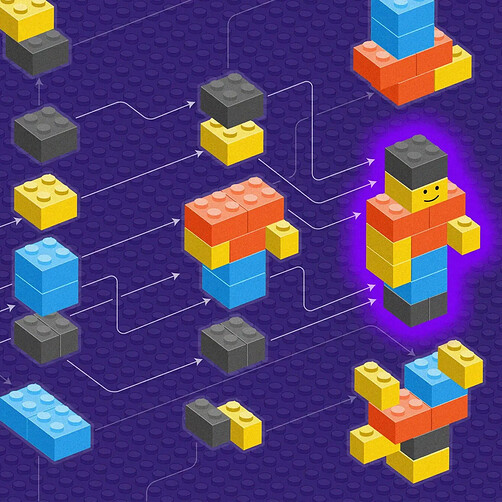
Assembly theory posits that complex systems emerge from simpler components combined through a series of steps. This framework can describe natural phenomena (like biological evolution), engineered systems (like blockchain protocols), and even conceptual systems like public goods funding mechanisms.
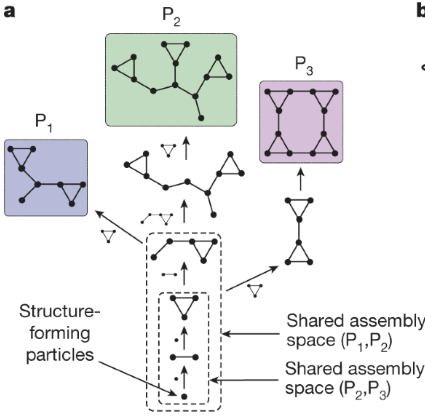
Assembly theory is a corollary of Gall's Law — which states that successful complex systems evolve from simple, functional ones, while complex systems designed from scratch often fail. It emphasizes starting with simplicity and iteratively building complexity to ensure adaptability and success.
In Assembly Theory, composability is a superpower because it allows complex systems to emerge from simpler building blocks, enabling the creation of highly sophisticated structures through iterative combination and reuse.
Purposeful Evolution
One key to assembly theory is understanding that complexity is not random; it emerges through purposeful or guided processes, constrained by physical, logical, or social rules.
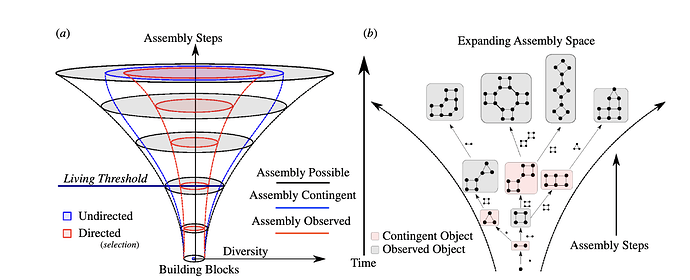
Assembly theory places guided and purposeful processes at the heart of how complexity emerges. These processes are not random but intentional, following specific pathways shaped by rules, goals, or constraints. Whether driven by natural selection, human decision-making, or computational algorithms, guided processes channel growth toward functional outcomes.
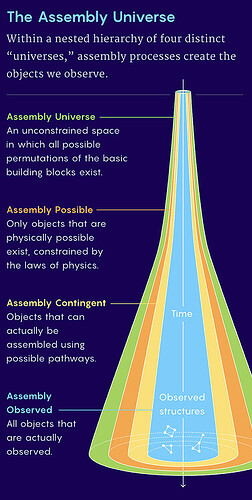
Purposeful processes work by leveraging feedback, iteration, and adaptation. In biological systems, evolution filters mutations through survival and reproduction. In human systems, innovation progresses through deliberate experimentation, learning, and refinement. A key feature is their reliance on constraints as guidance — channeling assembly into pathways that maximize efficiency and minimize waste.
What Do Advancements Look Like in Assembly Theory?
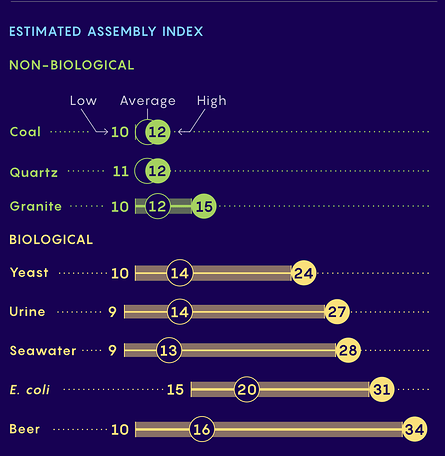
The complexity index measures the minimum number of sequential steps required to assemble a specific object or system. Higher values indicate more intricate and layered assembly pathways. This index can be used as a proxy for "advancedness" in evolution — the more complex an object, the more advanced its evolution from simpler elements.
However, complexity is not inherently a measure of fitness or utility. Bacteria, though simple, often outcompete complex organisms in extreme environments. Overly complex systems can become inefficient or vulnerable. Complexity's relationship to fitness depends on context.
Web3 and the "Money Legos" Analogy
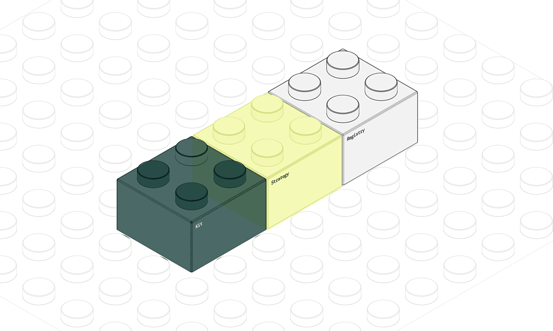
Web3 exemplifies modularity with its "money legos" concept. Protocols like Uniswap, Aave, and MakerDAO operate as composable parts — tools that developers can assemble in novel ways to create new financial products, decentralized applications, and governance systems.
Much like how Lego bricks encourage endless creations, Web3 protocols form a design space ripe for exploration. Developers can combine these foundational tools to craft systems tailored to specific use cases, from yield aggregators to quadratic funding platforms.
Onchain Capital Allocation as a Design Space
Onchain Capital Allocation — whether through Gitcoin Grants, retroactive public goods funding, or Allo protocol — represents another rich design space. Each tool or mechanism is a component in a larger assembly, capable of being recombined and optimized for different contexts.
Assembly theory helps frame this design space as a process of incremental discovery:
- What happens when you combine module A with module B?
- What happens when you mix quadratic voting with staking incentives?
- How might retroactive public goods funding integrate with DAO-based decision-making?
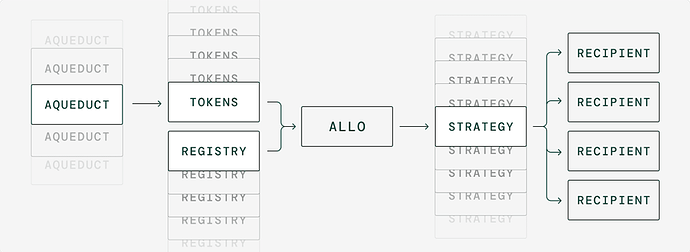
One way to start is to map out the different types of components in the possibility space:
Another way is to map out the permutations of program design possibilities:
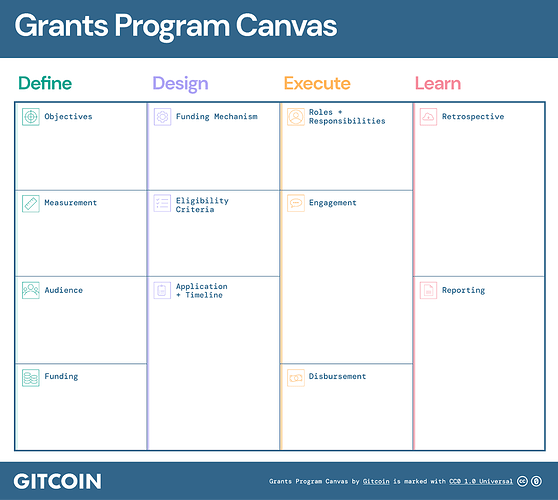
From there, we can reason about the most powerful pieces to combine. A naive approach might be a single team that combines components brute force and empirically tests whether the resulting circuit is useful.
An even more enlightened approach might ask how to explore this design space in a systematic, pluralistic way — guided by networked processing by multiple agents, much like how a decentralized organism, like a slime mold, explores the space around it.
Minecraft: Mining the Design Space
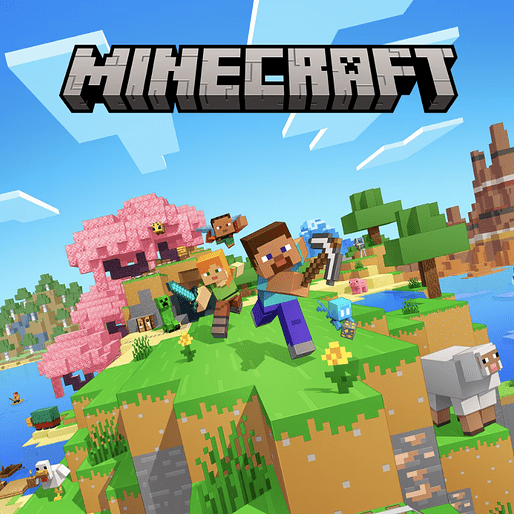
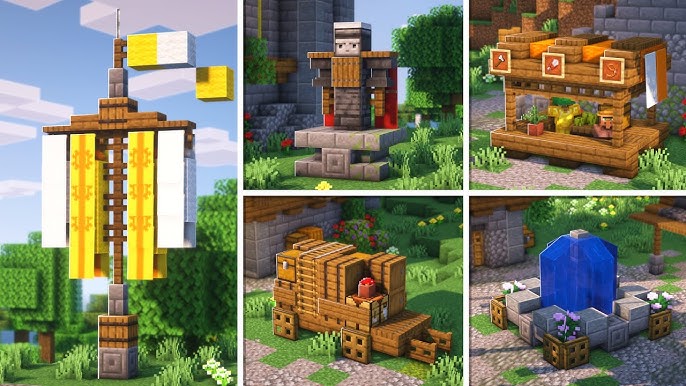
Minecraft thrives on simplicity, composability, and modularity, providing players with basic blocks and rules. Yet these elements allow for an infinite range of creations, from castles to computers.
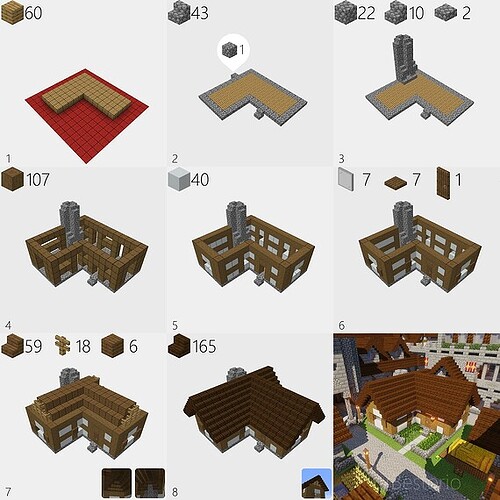
Minecraft succeeds because it makes the design space accessible, fun, and social. Players explore possibilities not out of obligation but because the game invites creativity. The game demonstrates that when you create a platform where exploration is encouraged, participants will mine the design space, discovering possibilities that even the creators couldn't have imagined.
Lessons for Onchain Capital Allocation
What if we applied Minecraft's ethos to the design space of Onchain Capital Allocation?
- Create Accessible Building Blocks: Simplify the process of combining mechanisms. Just as Minecraft makes placing blocks easy, Onchain Capital Allocation tools should offer intuitive, modular components.
- Foster a Fun, Profitable, and Social Environment: Encourage collaboration, gamify experimentation, and celebrate contributions.
- Encourage Play, Discovery, & Iterative Improvement: Provide environments where ideas can be tested, recombined, and improved, with clear feedback loops.
- Highlight Assembly Milestones: Share examples of successful assemblies, showcasing how others have used the building blocks in creative ways.
Conclusion: Assembling the Future
Assembly theory invites us to see systems not as static entities but as dynamic assemblages of parts that evolve over time. Web3's money legos, Onchain Capital Allocation mechanisms, and platforms like Minecraft exemplify the power of modularity and exploration.
By applying these principles, the community has the opportunity to create, lead, and participate in an evolutionary exploration of the Onchain Capital Allocation design space. By embracing modularity, collaboration, and iteration, we can uncover new ways to fund, sustain, and grow the systems that underpin our collective future.
Let's assemble something extraordinary.