Originally published: Allo Capital Research, December 2024
TLDR - Neural networks excel at recognizing patterns and making predictions from complex data. The concept of onchain capital allocation neural networks (AlloNets) draws lessons from neural networks to envision interconnected, adaptive decision-making and resource distribution in onchain ecosystems — optimizing capital distribution for public goods funding, collective action, and ecosystem growth.
From Biological Neural Networks to AI Neural Networks
A. Biological Neural Networks: Foundation of Inspiration
In the human brain, a neuron is the fundamental unit responsible for processing and transmitting information.
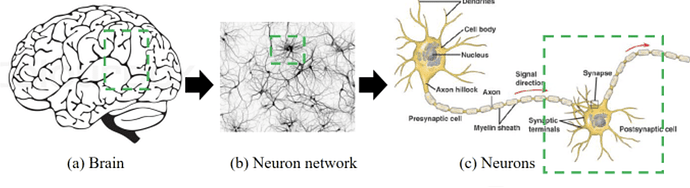
Each neuron receives input from other neurons through dendrites, processes this input within the cell body, and transmits an output signal through its axon to other neurons. The power of biological neural networks lies in their ability to process and integrate information from multiple sources, allowing for adaptive and flexible responses.
B. AI Neural Networks: Solving Complex Problems
AI neural networks are the digital counterparts of biological neural networks — simplified mathematical models designed for specific tasks like pattern recognition or data analysis.
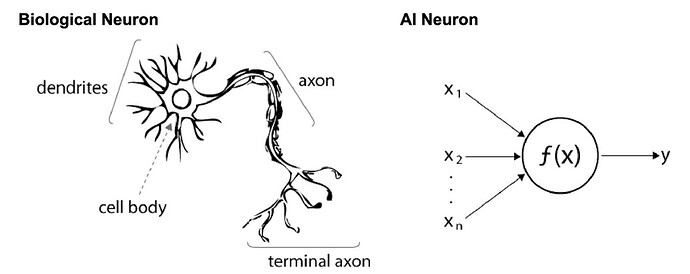
In AI, a neuron is a computational unit that takes input, performs a mathematical operation (such as a weighted sum), and produces an output passed to the next layer. These neurons are organized into layers: input layer receiving data, hidden layers performing intermediate computations, and output layer generating the final result.
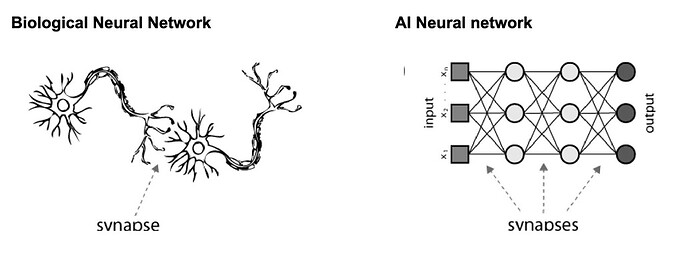
Through training techniques such as backpropagation and gradient descent, AI neural networks learn from data, adjust their internal parameters, and improve performance over time.
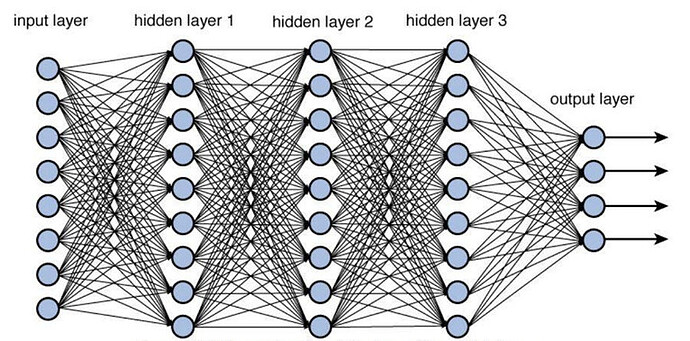
One key feature is their ability to solve complex problems by stacking multiple layers — forming what is known as a deep neural network.
AlloNets: The Emergence of a New Paradigm
As the world of blockchain and DAOs continues to grow, we are beginning to see the emergence of a new type of computational unit: the smart contract.
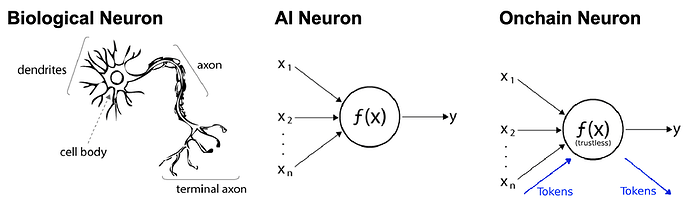
Smart contracts, when framed through the lens of neural networks, can be seen as an onchain neuron.
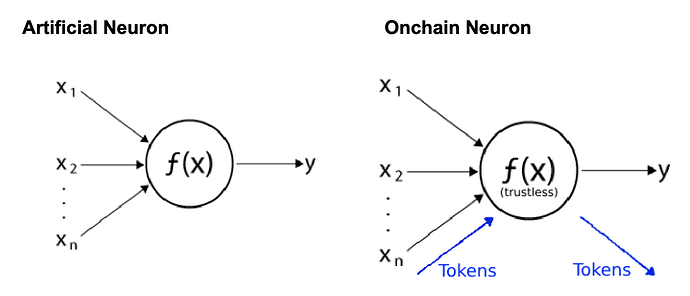
Just as AI neurons process and transmit information within a neural network, onchain neurons process and transmit information AND value within a decentralized network.
Onchain neurons are the atomic units of what can be termed as onchain capital allocation neural networks (AlloNets). AlloNets are composed of multiple smart contracts that work together to allocate capital across a decentralized ecosystem.
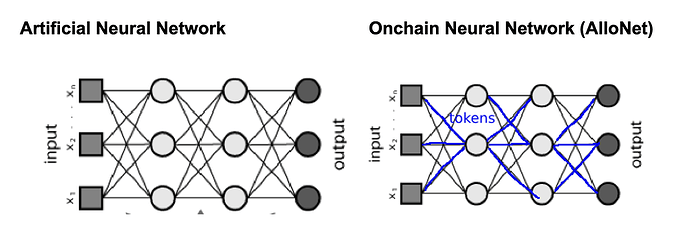
The architecture of an AlloNet draws a direct lineage from AI neural networks. Just as AI networks solve complex computational problems, AlloNets are evolving to solve complex financial and governance problems.
AlloNets: Real World Examples
Example A. Optimism RetroFunding
One example of an AlloNet in action is the Retro Funding ecosystem, driven by Optimism's $100m+ distribution to ecosystem public goods. Projects like libp2p and POKT received funds from OP Retro Funding and ran their own RetroFunding Rounds.
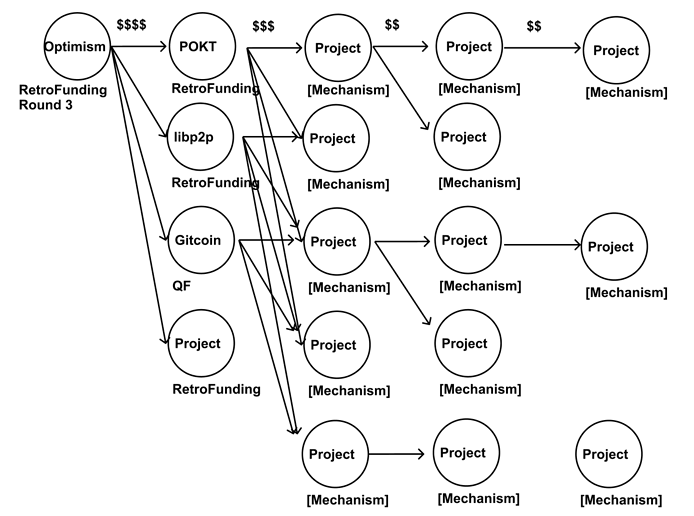
The propagation of tokens through this ecosystem visually resembles an AlloNet — each project acts as a neuron, propagating the funds forward (or not) based upon the rules embedded in its own locality.
Example B. Ethereum Ecosystem
Zooming out to the entire Ethereum space, we can see that larger AlloNets have emerged across the ecosystem.
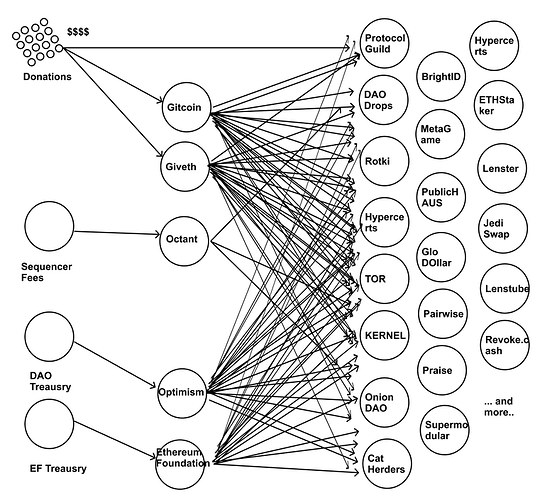
Types of Real-World Onchain Neurons
Examples of onchain neurons include:
- Gnosis Safe: Multi-signature wallet requiring approvals from designated signers
- Compound's Governance: Token holders vote on proposals determining fund allocation
- MolochDAO: Members propose how to allocate shared resources via voting
- Gitcoin Grants: Quadratic funding where community members contribute to supported projects
- EasyRetroFunding.xyz: Retroactive funding based on past contributions
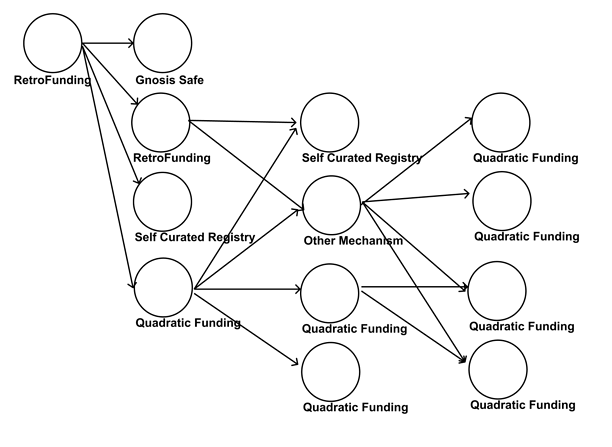
While each neuron may have a different allocation methodology, each shares the basic function of receiving, allocating, and distributing tokens. Each neuron also has its own constituency that governs it.
AlloNets: The Potential
The potential benefits of AlloNets are significant. By combining complementary properties of blockchains (global, transparent, incorruptible, programmable) and neural networks (recognizing patterns in complex data), we have a novel foundation for solving complex 21st century problems.
Key use cases:
- Public Goods Funding: Decentralized decisions made by networks of smart contracts based on criteria and community input
- Ecosystem Growth: Incentivizing development, rewarding contributors, dynamically adjusting allocation based on community feedback
- Decentralized Governance: Segmenting, defining, and executing resource allocation based on community outcomes
- Solving Coordination Failures: Combining the powerful properties of blockchains and neural networks
- Creating Collective Action: Aligning incentives and ensuring fair, transparent reward for contributions
- Economies of Scale: Network effects where more contributors and more funded projects reinforce each other
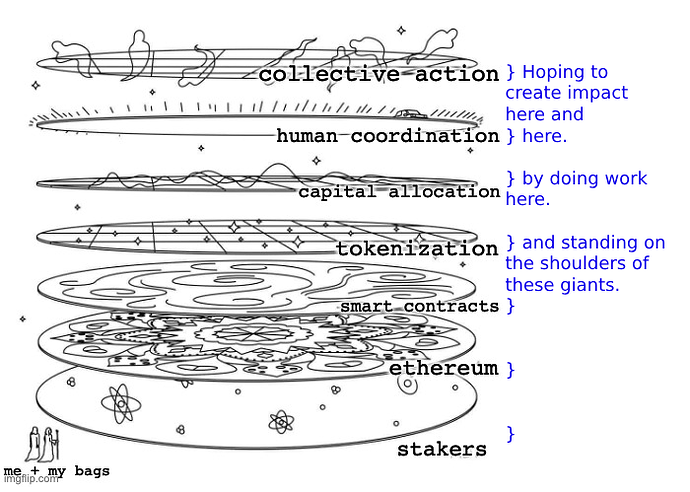
As more money is routed through AlloNets, they will continue to spin off more data and become more sophisticated. Protocol Guild exemplifies this — it has been funded by multiple neurons (Ethereum Foundation, Uniswap, ENS, Optimism, Balancer).
Conclusion
By drawing upon lessons from AI neural networks, we can envision a future where decentralized networks optimize capital distribution in complex sociopolitical ecosystems.
The concept of AlloNets represents a promising convergence of ideas from biology, AI, and blockchain technology. These networks have the potential to upgrade public goods funding, drive ecosystem growth, create collective action, and enable decentralized governance.
Realizing this vision will require overcoming significant challenges related to complexity, security, scalability, fragmentation, governance, and ethics. If we solve these problems, we can unlock new opportunities for decentralized finance and governance, and pave the way for a more coordinated, egalitarian future.