
TLDR: Gitcoin should evolve from a grants program into a modular ecosystem where builders compete to develop funding mechanisms — inspired by BitTensor's evolutionary model. Gitcoin provides distribution, builders bring innovation, and the best mechanisms win through natural selection.
Source: Gitcoin Governance Forum
Overview
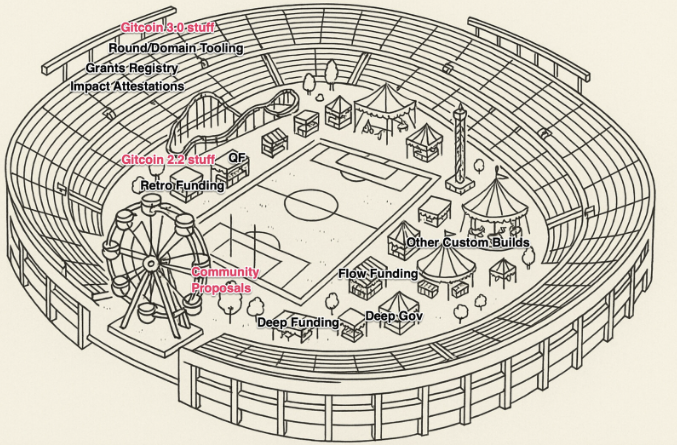
This proposal envisions evolving Gitcoin from a grants program into a modular ecosystem for capital allocation mechanisms. The vision centers on creating an "evolutionary arena" where builders compete to develop effective funding infrastructure while Gitcoin provides distribution and captures upside.
Three Core Goals for Gitcoin 3.3
- Address Ethereum's most pressing coordination challenges
- Advance capital allocation software development
- Achieve mutual benefit ("3,3,3,3") among stakeholders: the Ethereum ecosystem, builders, funders, and GTC token holders
The Evolutionary Arena Concept
The framework draws inspiration from BitTensor's Proof of Intelligence model. Different domains would function like specialized subnets, each targeting specific goals (developer onboarding, wallet adoption) and evaluated based on real-world outcomes — distribution, traction, and impact.
Gitcoin becomes an evolutionary substrate for funding infrastructure where successful approaches gain funding and visibility.
Allo.Capital's Role
Allo.Capital, described as an R&D studio, assists in designing capital allocation systems for ecosystem partners including Gitcoin and Big Green DAO.
Development Roadmap
- 3.0: Decentralize capital allocation development into specialized domains
- 3.1: Introduce tokenizable, extractable value (TEV) mechanisms
- 3.2: Build the BitTensor-inspired evolutionary arena
- 3.3: Create a compounding system benefiting all participants
Arguments Supporting the Vision
- Enables rapid iteration on funding mechanisms
- Aligns incentives for early-stage infrastructure builders
- Supports modular pluralism across mechanism types
- Decentralizes Gitcoin's roadmap
- Provides a transferable framework for other ecosystems
Key Criticisms and Concerns
Measurement Challenges: Comparing impact across retroactive funding, quadratic funding, and governance approaches presents significant evaluation difficulties.
Values vs. Metrics: Unlike algorithmic systems, capital allocation inherently involves ethical and political dimensions requiring human judgment.
Ecosystem Feedback: Experts cautioned that previous teams failed to generate sufficient cash flow for sustainable software development. Without breakthrough product-market fit, projects risk becoming "zombie" ventures. The network must capture majority revenue to prevent successful providers from departing.
Strategy Over Mechanism: Strategy and execution — not just mechanism design — must be the dominant selection pressures.
Community Voting
The proposal requested votes on three positions:
- FOR: Adopt the Gitcoin (3,3) vision
- AGAINST: Reject direction; maintain current approach
- ABSTAIN: Remain neutral or seek more information
Early responses showed support, with builders voting FOR due to potential arena exposure, while raising concerns about measuring success and identifying primary optimization targets.
Key Takeaway
The proposal represents a fundamental shift from Gitcoin as builder to Gitcoin as platform infrastructure. Success depends on addressing persistent challenges: impact measurement comparability, sustainable business models, and ensuring that mechanisms serve strategic objectives rather than becoming ends themselves.